AI-guided insurance shopping
A conversational assistant that helps customers explore coverage, scan their license, and get an auto insurance quote.
Explore the design approach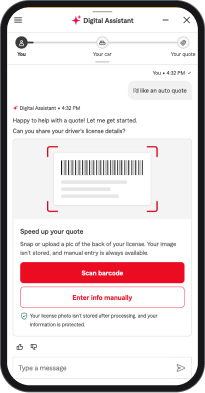
01 / CUSTOMER NEEDS
Design around the customer’s next step.
These task lenses translate the documented project direction into clear design priorities. They summarize the work; they are not presented as original participant profiles.
A customer exploring insurance
Understand what information is needed and move through unfamiliar coverage decisions with confidence.
02 / DESIGN ARTIFACTS
From customer need to a clearer next step.
Browse the key screens, trace the interaction model, or try the original prototype.
PROTOTYPE SCREEN 01
Give customers a choice
The mobile quote concept offers license scanning alongside manual entry, with a privacy message next to the action.
Open interactive prototype in a new tab03 / DESIGN APPROACH
Connect customer intent, interaction, and delivery.
I explored how Digital Assistance could make insurance shopping feel clearer: start with the customer’s goal, combine conversation with useful interface controls, and keep the next step visible. This portfolio focuses on the shopping prototype within my broader State Farm AI and Digital Assistance work.
- 01
Experience strategy
Defined an assistance approach around the customer’s goal and connected shopping and quoting with the broader Digital Assistance strategy.
- 02
Interaction design
Explored conversation alongside traditional controls, contextual guidance, suggestion chips, and transitions to human support.
- 03
Research & shared standards
Directed prototypes and experimentation, and aligned Product, Research, Data Science, and Engineering through the Digital Assistance Design Kit and shared experience principles.
04 / RESEARCH & VALIDATION
Grounded in research. Measured with care.
These records summarize broader program research and design rationale. Participant-level findings and quote-specific outcome measures are not included here.
Broader State Farm program evidence that framed the opportunity for clearer guidance and human handoff. These figures are not results from this specific prototype.
Can people find the assistance?
Evaluate entry points, CTA language, visual identity, and suggestion chips in the context of the customer’s task.
Does the interaction feel clear and trustworthy?
Test whether customers understand the request, the available alternatives, and the privacy language around information sharing.
Can people move forward or get help?
Evaluate continuity between conversation and traditional controls, recovery paths, and transitions to human support.
Validation focus: task completion, understanding and trust, plus the ability to continue or reach human help. No quote-conversion lift is claimed.